
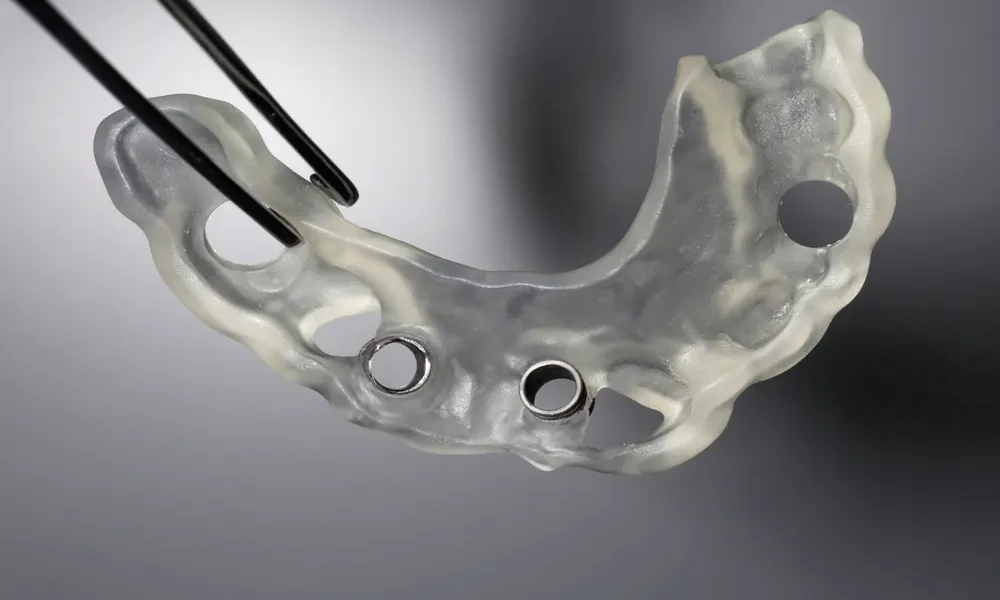
Implant surgical guides have transformed the predictability of dental implant placement over the past decade, translating the precision of digital implant planning directly into the surgical field. Yet the quality of that translation, the degree to which the planned implant position is actually achieved in the patient, depends not only on the accuracy of the digital planning and the fit of the guide but critically on the dimensional accuracy of the printed guide itself. And the dimensional accuracy of the printed guide depends on the specific dental surgical guide material used to print it. Among the options available to US dental labs, Whip Mix VeriGuide Clear represents a purpose-engineered surgical guide resin whose properties are specifically validated for the accuracy demands of implant guide fabrication.
Why Surgical Guide Accuracy Is Non-Negotiable
An implant surgical guide controls the angulation, depth, and position of each implant by constraining the surgical drill within a precisely positioned sleeve. The guide’s role is to transfer the digital implant plan, designed on a CT scan with millimeter-level precision, into the patient’s mouth with equivalent accuracy. Any dimensional error introduced by the printing process, whether from resin shrinkage during polymerization, layer-stepping artifacts, or thermal distortion during or after printing, translates directly into deviation between planned and actual implant position. In the worst cases, this deviation can compromise prosthetic fit, violate anatomical boundaries, or affect implant osseointegration.
Surgical guide resin Whip Mix formulations address this accuracy requirement by engineering the resin’s photopolymerization behavior, shrinkage characteristics, and post-cure dimensional stability to minimize the sources of error that generic resins introduce. A clear guide resin for 3D printing that is validated specifically for surgical guide applications provides the dimensional accuracy evidence that a general-purpose biocompatible resin adapted for the application cannot offer.
Properties That Define a Quality Surgical Guide Resin
Dental surgical guide material quality is determined by several interrelated properties. Dimensional accuracy during printing, which depends on the resin’s photopolymerization behavior and the printer’s calibration, determines whether the printed guide matches the digital design file within clinically acceptable tolerances. Rigidity in the cured state determines whether the guide maintains its position and sleeve orientation during the surgical procedure without flexing or deforming under the loads imposed by drilling. Biocompatibility for intraoral contact is required for any material that will be placed in the patient’s mouth, even temporarily during a surgical procedure.
3D printed resin Whip Mix VeriGuide Clear is specifically engineered to deliver across all of these dimensions. Its clarity is not merely a visual property: it allows the clinician to verify seating against the mucosa or remaining dentition and to monitor the position of the drill during guided placement, adding an additional verification step to the placement procedure.
The Role of Post-Processing in Guide Accuracy
The dimensional accuracy of a 3D printed resin Whip Mix surgical guide is determined not only by the printing step but by the complete post-processing protocol. Inadequate washing to remove uncured resin from the guide’s interior surfaces, incomplete post-cure exposure that leaves the resin in an undercured state with reduced rigidity, or post-processing in conditions that allow thermal distortion can each compromise the guide’s dimensional accuracy even when the printing step itself was performed correctly. Following the manufacturer’s validated post-processing protocol for whip mix VeriGuide clear is not optional: it is the step that completes the curing process and ensures the guide reaches its specified dimensional and mechanical properties.
Integration With Digital Implant Planning Workflow
The clear guide resin for 3D printing integrates with surgical guide design software that exports STL files from CBCT-based implant planning to a compatible 3D printer. The guide’s dimensional accuracy is only as good as the complete workflow: accurate CBCT data, correct virtual implant positioning, properly oriented and supported printing, and correctly executed post-processing. Validating each element of this workflow, including periodic dimensional verification of printed test guides against their digital designs, is the practice that ensures the delivered guide achieves the implant placement accuracy that digital guided surgery promises.
____________________________________________________________________________________